Conferência On-line de Biologia celular e molecular

.
Evento on-line gratuito. Dia 16 de Fevereiro de 1012.
Mais informações: www.targetmeeting.com

TM’s 1st world molecular and cell biology online conference

Date: 2/16/2012
Time: 8:00 AM EDT (New York) / 2:00 PM CET (Europe)
Categories: Biochemistry, Cancer, Cell Biology, Molecular Biology, Biology, Structural Biology, Technology
Type: Conference
Register Deadline: 2/15/2012
Publicado em evento, notícias | Deixe um comentário

O desafio da divulgação científica democrática

Cracking Open the Scientific Process

Artigo do NY Times: http://www.nytimes.com/2012/01/17/science/open-science-challenges-journal-tradition-with-web-collaboration.html?_r=1&src=me&ref=general

Publicado em ciência, notícias | Deixe um comentário

cAMP inhibits mammalian target of rapamycin complex-1 and -2 (mTORC1 and 2) by promoting complex dissociation and inhibiting mTOR kinase activity.


O estudo de Xie et al (2012) publicado essa semana no Cellular Signalling apresenta novos dados que auxiliam na compreensão acerca da regulação do complexo mTORC1, evidenciando uma ação inibitória do segundo AMPc sobre este complexo.

Cell Signal. 2011 Dec;23(12):1927-35. Epub 2011 Jul 6.

Source

Department of Cell Physiology and Pharmacology, University of Leicester, The Henry Wellcome Building, University Road, Leicester LE1 9HN, UK.

Abstract

cAMP and mTOR signalling pathways control a number of critical cellular processes including metabolism, protein synthesis, proliferation and cell survival and therefore understanding the signalling events which integrate these two signalling pathways is of particular interest. In this study, we show that the pharmacological elevation of [cAMP](i) in mouse embryonic fibroblasts (MEFs) and human embryonic kidney 293 (HEK293) cells inhibits mTORC1 activation via a PKA-dependent mechanism. Although the inhibitory effect of cAMP on mTOR could be mediated by impinging on signalling cascades (i.e. PKB, MAPK and AMPK) that inhibit TSC1/2, an upstream negative regulator of mTORC1, we show that cAMP inhibits mTORC1 in TSC2 knockout (TSC2(-/-)) MEFs. We also show that cAMP inhibits insulin and amino acid-stimulated mTORC1 activation independently of Rheb, Rag GTPases, TSC2, PKB, MAPK and AMPK, indicating that cAMP may act independently of known regulatory inputs into mTOR. Moreover, we show that the prolonged elevation in [cAMP](i) can also inhibit mTORC2. We provide evidence that this cAMP-dependent inhibition of mTORC1/2 is caused by the dissociation of mTORC1 and 2 and a reduction in mTOR catalytic activity, as determined by its auto-phosphorylation on Ser2481. Taken together, these results provide an important insight into how cAMP signals to mTOR and down-regulates its activity, which may lead to the identification of novel drug targets to inhibit mTOR that could be used for the treatment and prevention of human diseases such as cancer.
Copyright © 2011 Elsevier Inc. All rights reserved.

PMID:


21763421


[PubMed – indexed for MEDLINE] 
PMCID: PMC3189512


Artigo completo: http://www.ncbi.nlm.nih.gov/pmc/articles/PMC3189512/

Publicado em fisiologia, paper, plasticidade muscular, sinalização celular | Deixe um comentário

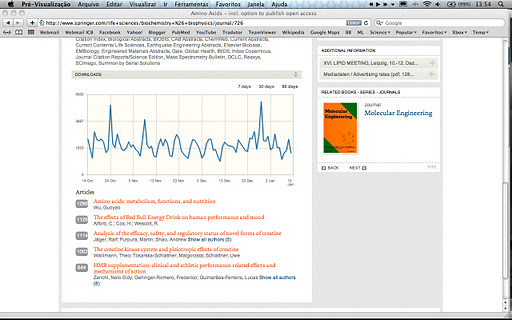
Revisão sobre HMB no Top 6 de Downloads do Amino Acids Journal

Nossa revisão sobre suplementação de HMB publicada em 2011 aparece entre os 6 artigos mais baixados do site do Amino Acids Journal nos últimos 90 dias.
Publicado em paper | Deixe um comentário

Chronic hypobaric hypoxia mediated skeletal muscle atrophy: role of ubiquitin-proteasome pathway and calpains

Este trabalho de Chaudhary et al. auxilia na compreensão dos efeitos da altitude sobre a musculatura esquelética. Apesar do aumento da taxa de síntese protéica em ~1,5 vezes, a proteólise aumento cerca de 5 vezes. Os sistemas ubiquitina proteassoma e dependente das calpaínas paracem atuar de forma importante para estes efeitos. Tais efeitos ocorreram em paralelo à perda de massa muscular dos animais e degradação de proteínas, especialmente proteínas miofibrilares.

Chronic hypobaric hypoxia mediated skeletal muscle atrophy: role of ubiquitin-proteasome pathway and calpains

Mol Cell Biochem. 2012 Jan 4. [Epub ahead of print]

Chaudhary P, Suryakumar G, Prasad R, Singh SN, Ali S, Ilavazhagan G.

Source

Defence Institute of Physiology and Allied Sciences, Lucknow Road, Timarpur, New Delhi, 110054, India.

Abstract

The most frequently reported symptom of exposure to high altitude is loss of body mass and decreased performance which has been attributed to altered protein metabolism affecting skeletal muscles mass. The present study explores the mechanism of chronic hypobaric hypoxia mediated skeletal muscle wasting by evaluating changes in protein turnover and various proteolytic pathways. Male Sprague-Dawley rats weighing about 200 g were exposed to hypobaric hypoxia (7,620 m) for different durations of exposure. Physical performance of rats was measured by treadmill running experiments. Protein synthesis, protein degradation rates were determined by (14)C-Leucine incorporation and tyrosine release, respectively. Chymotrypsin-like enzyme activity of the ubiquitin-proteasome pathway and calpains were studied fluorimetrically as well as using western blots. Declined physical performance by more than 20%, in terms of time taken in exhaustion on treadmill, following chronic hypobaric hypoxia was observed. Compared to 1.5-fold increase in protein synthesis, the increase in protein degradation was much higher (five-folds), which consequently resulted in skeletal muscle mass loss. Myofibrillar protein level declined from 46.79 ± 1.49 mg/g tissue at sea level to 37.36 ± 1.153 (P < 0.05) at high altitude. However, the reduction in sarcoplasmic proteins was less as compared to myofibrillar protein. Upregulation of Ub-proteasome pathway (five-fold over control) and calpains (three-fold) has been found to be important factors for the enhanced protein degradation rate. The study provided strong evidences suggesting that elevated protein turnover rate lead to skeletal muscle atrophy under chronic hypobaric hypoxia via ubiquitin-proteasome pathway and calpains.
Publicado em fisiologia, Músculo, paper, plasticidade muscular | Deixe um comentário

Protein supplementation in strength and conditioning adepts: knowledge, dietary behavior and practice in Palermo, Italy.

J Int Soc Sports Nutr. 2011 Dec 29;8(1):25. [Epub ahead of print]

Bianco AMammina CPaoli ABellafiore MBattaglia GCaramazza GPalma AJemni M.

ABSTRACT:

BACKGROUND:

It is known that supplement use is a widespread and accepted practice by athletes and people who attend commercial gyms. Little is known about protein supplement amongst people undertaking strength training in commercial gyms in Italy when compared to the US.

OBJECTIVE:

The purpose of this study was to examine the use of protein supplementation, alone or in association with other supplements, and dietary behavior amongst regular fitness center attendees in Palermo, Italy.

DESIGN:

Resistance training information have been collected from 800 regular fitness center attendees for the initial analysis. A specific questionnaire was generated for the experimentation. Data were collected using a face-to-face interview method. Supplement users were then compared to the non users and analyzed using a one-way ANOVA, Kruskall-Wallis, chi-square test or exact test of Fisher when appropriate.

RESULTS:

30.1% of the respondents use dietary supplements during their training as a believe it is the “way to gain muscles and strength”. Whey protein shakes (50.0%) mixed with creatine and amino-acids (48.3%) were the most frequent choices amongst the users. A majority of the subjects (34.0%) appeared to rely on their gym instructors’ advice for their intake; a lower proportion (13.0%) consulted physicians, while none of them consulted nutritionists. A high consumption of milk has been noticed in both users (67,7%) and non-users (52,8%); supplement non-users consumed significantly more snacks and bakery products than users per week (P < 0.001), while users consumed significantly more protein-rich foods (P<0.01) with a particular preference for meat (48.0%).

CONCLUSIONS:

A considerable number of regular strength training adepts consume protein supplements mixed with other products (mainly creatine and amino-acids). Limited numbers consult “dietary specialists” and rely mainly on their instructors. We emphasize on the importance of the dissemination of scientifically based information about supplementation in this environment and the promotion of updated educational programs for the instructors.