Controle de Qualidade no PCR em Tempo Real

QUALITY CONTROL – EFFICIENCY CURVES 

Here is a list of the criteria we apply in the lab before we accept the data for efficiency from a dilution curve
  • use PCR baseline subtraction (not curve fitting default option)
  • set the threshold manually to lab standard
  • check all melting curves are OK
  • check slopes are parallel in log view
  • delete samples if multiple dilutions cross line together (usually at dilute end of curve)
  • delete samples if can detect amplification at cycle 10 or earlier
  • make sure there are 5 or more points
  • check that correlation coefficient is more than 0.990
Publicado em protocolos | Deixe um comentário

Proteína de duas caras: c-JUN pode atuar a favor ou contra o câncer

Do portal Ciência Diária.

Representação em 3D do oncogene JUN. Crédito: domínio público.

Representação em 3D do oncogene JUN. Crédito: domínio públicoErros no processo da bioquímica complexa de divisão celular levam ao câncer frequentemente. A proteína c-JUN, um fator de transcrição, está diretamente envolvida no processo de câncer. Uma equipe da Universidade de Medicina Veterinária de Viena, Áustria, acaba de descobrir uma função adicional da c-JUN que também pode ajudar a combater o câncer: ativa um gene que inibe o crescimento de tumores. Os resultados foram publicados na revista Oncotarget recentemente.
O fator de transcrição c-JUN foi descrito, na década de 1980, como uma proteína de mamífero muito semelhante a uma proteína responsável por causar câncer em aves. Desde então, várias pesquisas intensificadas em muitos laboratórios ao redor do mundo levaram a uma compreensão fundamental do papel do fator c-JUN no desenvolvimento do câncer. O c-JUN é um fator de transcrição que modifica (fosforila) as proteínas chaves reguladoras nas células. Ao ativar ou desativar as células, este fator conduz à divisão celular desregulada que leva ao crescimento descontrolado de um câncer. Também já é sabido que a c-JUN não atua por conta própria, mas em conjunto com outras proteínas que regulam suas funções.
Karoline Kollmann, membro da equipe de Veronika Sexl no Instituto de Farmacologia e Toxicologia da referida universidade, havia publicado um trabalho em conjunto com parceiros das universidades de Medicina de Viena e Madrid na Espanha, onde descrevia outra função da proteína c-JUN. Este fator se ligaria ao agente do gene quinase, conhecido como CDK6, assim prevenindo o gene de ser inativado (por meio de metilação).  O resultado seria o aumento da atividade deste agente nas células cancerosas, atividade que estimularia a progressão mais rápida da doença.
Proteína com duas faces
O aspecto surpreendente da atual descoberta é que a função “nova” do c-JUN é independente da atividade normal da proteína. Kollmann acaba de adicionar um “toque a mais” aos estudos anteriores, com a descoberta de que o c-JUN protege não apenas o gene Cdk6 – assim, acelerando a formação de tumores – mas também o gene p16 INK4a. O p16 INK4a é um gene supressor de tumor conhecido e sua mutação ou inativação está associada a um risco aumentado de contrair uma variedade de formas de câncer. Protegendo o agente deste gene da inativação, c-JUN parece estar ajudando as células a combater o câncer.
Desordem bioquímica
Isso significa que uma vilã central no desenvolvimento do câncer não é realmente tão ruim como se pensava anteriormente? Kollmann responde cautelosamente: “Eu acho que significa que a função de todas essas proteínas é muito mais complexa do que conhecemos hoje. Todas trabalham em conjunto com muitas outras proteínas e o efeito global depende de um grande número de fatores. Devemos aprender a entender melhor estes mecanismos antes de sabermos o que precisamos e inibir as proteínas-alvo para tratar o câncer de forma mais eficaz”.

Publicado em bioquímica, câncer, fisiologia, notícias | Deixe um comentário

Dicas para solucionar os problemas em seu Western Blotting

Western blot troubleshooting tips

1. No signal

The primary antibody and the secondary antibody are not compatible.
Use secondary antibody that was raised against the species in which the primary was raised (e.g primary is raised in rabbit, use anti-rabbit secondary).

Not enough primary or secondary antibody is bound to the protein of interest.
Use more concentrated antibody. Incubate longer (e.g. overnight) at 4ºC.

Cross-reaction between blocking agent and primary or secondary antibody.
Use a mild detergent such as Tween20 or switch blocking reagent (i.e. commonly used blocking reagents are milk, BSA, serum or gelatin).

The primary antibody does not recognize the protein in the species being tested.
Check the datasheet or perform a ClustalW alignment to ensure your antibody should react with the target protein; Run the recommended positive control.

Insufficient antigen.
Load at least 20-30 μg protein per lane; Use protease inhibitors; Run the recommended positive control.

The protein of interest is not abundantly present in the tissue.
Use an enrichment step to maximize the signal (e.g. prepare nuclear lysates for a nuclear protein, etc.).

Poor transfer of protein to membrane.
Check the transfer with a reversible stain such as Ponceau S; check that the transfer was not performed the wrong way; if using PVDF membrane make sure you pre-soak the membrane in MeOH then in transfer buffer.

Excessive washing of the membrane.
Do not over wash the membrane.
Too much blocking does not allow you to visualize your protein of interest.
Instead of using 5% milk in the antibody buffers try removing the milk or using 0.5%. Switch blocking
reagents or block for less time.

Over-use of the primary antibody.
Use fresh antibody as the effective concentration is lowered upon each re-use.

Secondary antibody inhibited by sodium azide.
Do not use sodium azide together with HRP-conjugated antibodies.

Detection kit is old and substrate is inactive.
Use fresh substrate.

2. High background

Blocking of non-specific binding might be absent or insufficient.
Increase the blocking incubation period and consider changing blocking agent. Abcam recommends 5% non-fat dry milk, 3% BSA, or normal serum for 30 min. These can be included in the antibody buffers as well.

The primary antibody concentration may be too high.
Titrate the antibody to the optimal concentration, incubate for longer but in more dilute antibody (a slow but targeted binding is best).

Incubation temperature may be too high.
Incubate blot at 4°C.

The secondary antibody may be binding non-specifically or reacting with the blocking reagent.
Run a secondary control without primary antibody.

Cross-reaction between blocking agent and primary or secondary.
Add a mild detergent such as Tween20 to the incubation and washing buffer (phospho-specific protein). Milk contains casein which is a phosphoprotein; this is why it causes high background because the phospho-specific antibody detects the casein present in the milk. Use BSA as a blocking reagent instead of milk.

Washing of unbound antibodies may be insufficient.
Increase the number of washes.

Your choice of membrane may give high background.
Nitrocellulose membrane is considered to give less background than PVDF.

The membrane has dried out.
Care should be taken to prevent the membrane from drying out during incubation.

3. Multiple bands

Cell lines that have been frequently passaged gradually accumulate differences in their protein expression profiles.
Go back to the original non-passaged cell line and run the current and original cell line samples in parallel.

The protein sample has multiple modified forms in vivo such as acetylation, methylation, myristylation, phosphorylation, glycosylation etc.
Examine the literature and use an agent to dephosphorylate, de-glycosylate, etc. the protein to bring it to the correct size.

The target in your protein sample has been digested (more likely if the bands are of lower molecular weight).
Make sure that you incorporate sufficient protease inhibitors in your sample buffer.

Unreported novel proteins or different splice variants that share similar epitopes and could possibly be from the same protein family are being detected.
Check the literature for other reports and also perform a BLAST search; Use the cell line or tissue reported on the datasheet.

Primary antibody concentration is too high – at high concentration multiple bands are often seen.
Try decreasing the antibody concentration and/or the incubation period.

Secondary antibody concentration is too high – at high concentration secondaries will bind nonspecifically.
Try decreasing the concentration. Run a secondary antibody control (without the primary).

The antibody has not been purified.
Try to use affinity purified antibody. This will often remove non-specific bands.

The bands may be non-specific.
Where possible use blocking peptides to differentiate between specific and non-specific bands. Only specific bands should be blocked (and thus disappear).

The protein target may form multimers.
Try boiling in SDS-PAGE for 10 minutes rather than 5 minutes to disrupt multimers.

4. Uneven white “spots”on the blot

Air bubbles were trapped against the membrane during transfer or the antibody is not evenly spread on the membrane.
Make sure you remove bubbles when preparing the gel for transfer. Incubate antibodies under agitation.

5. Black dots on the blot

The antibodies are binding to the blocking agent.
Filter the blocking agent.

6. White bands on a black blot (negative of expected blot)

Too much primary and/or too much secondary antibody.
Dilute the antibodies more.

7. MW marker lane is black

The antibody is reacting with the MW marker.
Add a blank lane between the MW marker and the first sample lane.

8. The band of interest is very low/high on the blot

Separation is not efficient.
Change the gel percentage: a higher percentage for small protein, lower percentage for large proteins.

9. Smile effect of the bands

1. Migration was too fast
2. Migration was too hot (changing the pH and altering the migration).
Slow down the migration or run the gel in the cold room or on ice.

10. Uneven band size in lanes probed for the same protein

Gel has set too quickly while casting and the acrylamide percentage is not even along the lanes.
Review the recipe of the gel and the addition of TEMED to the gels, add a little 0.1% SDS in water to the top of the migrating gel while it sets to stop it from drying.

11. Uneven staining of the gel

Contamination from bacteria
Keep antibodies at 4°C and use fresh buffers covers the gel.

Not enough antibody
Make sure the membrane is covered with the antibody/ incubate under agitation.

——————————————————–

Fonte: http://www.abcam.com/
Versão em pdf: http://www.abcam.com/ps/pdf/protocols/abcam_troubleshooting_tips_WB.pdf

Publicado em protocolos | Deixe um comentário

Relação entre Composição Corporal e Resistência à Insulina em Diabéticas tipo II

Composição corporal, síndrome metabólica e resistência insulínica no diabetes melito tipo 1

Arq Bras Endocrinol Metab vol.55 no.3 São Paulo abr. 2011

Denise Prado MomessoI; Isabela BussadeI, II; Giovanna A. Balarini LimaI; Leniane Pereira Coelho FonsecaI; Luis Augusto Tavares RussoIII; Rosane KupferI


RESUMO
OBJETIVO: Avaliar a relação entre composição corporal, síndrome metabólica (SM) e resistência insulínica (RI) no diabetes tipo 1 (DM1).
SUJEITOS E MÉTODOS: Quarenta e cinco mulheres com DM1 (36 ± 9 anos; índice de massa corporal 24,6 ± 4,4 kg/m2) foram submetidas à análise de composição corporal e RI por meio de densitometria por dupla emissão de raios-X e taxa de disponibilização de glicose estimada (eGDR), respectivamente. Vinte mulheres (45%) apresentavam SM, conforme critérios da Organização Mundial da Saúde (OMS).
RESULTADOS: Mulheres com SM apresentaram maior gordura central e menor eGDR do que as sem SM (41,9 ± 2,0 vs. 33,7±1,8%; p = 0,004 e 4,99 ± 0,40 vs. 8,37 ± 0,39; p < 0,0001). A gordura corporal total e a gordura periférica não diferiram entre os grupos. A gordura central foi inversamente correlacionada com eGDR (r = -0,33; p = 0,03).
CONCLUSÃO: Deposição de gordura central em mulheres jovens não obesas com DM1 esteve associada com SM e RI. Avaliação da composição corporal pode ser importante na identificação de pacientes com risco metabólico elevado.
Descritores: Diabetes tipo 1; composição corporal; síndrome metabólica; resistência insulínica.

Publicado em diabetes, fisiologia, paper, saúde | Deixe um comentário

Artigo sobre Doping Genético

Saiu na Revista Brasileira de Medicina do Esporte:

Genética, performance física humana e doping genético: o senso comum versus a realidade científica


Rev Bras Med Esporte vol.17 no.1 Niterói jan./fev. 2011

Autor: Rodrigo Gonçalves Dias

Resumo:


Atletas de elite são reconhecidos como fenômenos esportivos e o potencial para atingir níveis superiores de performance no esporte está parcialmente sob o controle de genes. A excelência atlética é essencialmente multifatorial e determinada por complexas interações entre fatores ambientais e genéticos. Existem aproximadamente 10 milhões de variantes genéticas dispersas por todo o genoma humano e uma parcela destas variantes têm demonstrado influenciar a responsividade ao treinamento físico. Os fenótipos de performance física humana parecem ser altamente poligênicos e alguns estudos têm comprovado a existência de raras combinações genotípicas em atletas. No entanto, os mecanismos pelos quais genes se interagem para amplificar a performance física são desconhecidos. O conhecimento sobre os genes que influenciam a treinabilidade somado ao potencial uso indevido dos avanços da terapia gênica, como a possível introdução de genes em células de atletas, fez surgir o termo doping genético, um novo e censurado método de amplificação da performance física, além dos limites fisiológicos. Aumentos na hipertrofia muscular esquelética e nos níveis de hematócrito estão sendo conseguidos através da manipulação da expressão de genes específicos, mas a grande parte das impressionáveis alterações foi obtida em experimentação com animais de laboratório. A compreensão dos resultados científicos envolvendo genética, performance física humana e doping genético é uma difícil tarefa. Com o propósito de evitar a contínua má interpretação e propagação de conceitos errôneos, esta revisão, intencionalmente, vem discutir as evidências científicas produzidas até o momento sobre o tema, permitindo a compreensão do atual “estado da arte”.


Palavras-chave: genes, variantes genéticas, performance física, atletas de elite, doping.

[ Link ]
Publicado em doping, fisiologia, paper, treinamento | Deixe um comentário

Suplementação de Leucina e sinalização da insulina em ratos.

Saiu no Journal of Nutritional Biochemistry:

Leucine supplementation in rats induced a delay in muscle IR/PI3K signaling pathway associated with overall impaired glucose tolerance.

J Nutr Biochem. 2011 Mar;22(3):219-26. Epub 2010 Jun 16.


Source

Inra, UMR 1019 Nutrition Humaine, F-63122 Saint Genés Champanelle, France. balage@clermont.inra.fr

Abstract

Although activation of the mammalian target of rapamycin complex/p70 S6 kinase (S6K1) pathway by leucine is efficient to stimulate muscle protein synthesis, it can also exert inhibition on the early steps of insulin signaling leading to insulin resistance. We investigated the impact of 5-week leucine supplementation on insulin signaling and sensitivity in 4-month old rats fed a 15% protein diet supplemented (LEU) or not (C) with 4.5% leucine. An oral glucose tolerance test was performed in each rat at the end of the supplementation and glucose transport was measured in vitro using isolated epitrochlearis muscles incubated with 2-deoxy-d-[(3)H]-glucose under increasing insulin concentrations. Insulin signaling was assessed on gastrocnemius at the postabsorptive state or 30 and 60 min after gavage with a nutrient bolus. Tyrosine phosphorylation of IRβ, IRS1 and PI3 kinase activity were reduced in LEU group 30 min after feeding (-36%, -36% and -38% respectively, P<.05) whereas S6K1, S6rp and 4EBP1 phosphorylations were similar. Overall glucose tolerance was reduced in leucine-supplemented rats and was associated with accumulation of perirenal adipose tissue (+27%, P<.05). Conversely, in vitro insulin-response of muscle glucose transport tended to be improved in leucine-supplemented rats. In conclusion, dietary leucine supplementation in adult rats induced a delay in the postprandial stimulation in the early steps of muscle insulin signaling without muscle resistance on insulin-induced glucose uptake. However, it resulted in overall glucose intolerance linked to increased local adiposity. Further investigations are necessary to clearly define the beneficial and/or deleterious effects of chronic dietary leucine supplementation in healthy subjects.
Copyright © 2011 Elsevier Inc. All rights reserved.

PMID:

 20558053  

[PubMed – indexed for MEDLINE]
Publicado em aminoácidos, nutrição, paper, suplementação | Deixe um comentário

Cientistas fazem ratos paralíticos andarem novamente [artigo em inglês]

Scientists Make Paralyzed Rats Walk Again After Spinal-Cord Injury

ScienceDaily (Sep. 21, 2009) — UCLA researchers have discovered that a combination of drugs, electrical stimulation and regular exercise can enable paralyzed rats to walk and even run again while supporting their full weight on a treadmill.

090920204455-large.jpg
Published Nov. 20 in the online edition of Nature Neuroscience, the findings suggest that the regeneration of severed nerve fibers is not required for paraplegic rats to learn to walk again. The finding may hold implications for human rehabilitation after spinal cord injuries.
“The spinal cord contains nerve circuits that can generate rhythmic activity without input from the brain to drive the hind leg muscles in a way that resembles walking called ‘stepping,'” explained principal investigator Reggie Edgerton, a professor of neurobiology and physiological sciences at the David Geffen School of Medicine at UCLA.
“Previous studies have tried to tap into this circuitry to help victims of spinal cord injury,” he added. “While other researchers have elicited similar leg movements in people with complete spinal injuries, they have not achieved full weight-bearing and sustained stepping as we have in our study.”
Edgerton’s team tested rats with complete spinal injuries that left no voluntary movement in their hind legs. After setting the paralyzed rats on a moving treadmill belt, the scientists administered drugs that act on the neurotransmitter serotonin and applied low levels of electrical currents to the spinal cord below the point of injury.
The combination of stimulation and sensation derived from the rats’ limbs moving on a treadmill belt triggered the spinal rhythm-generating circuitry and prompted walking motion in the rats’ paralyzed hind legs.
Daily treadmill training over several weeks eventually enabled the rats to regain full weight-bearing walking, including backwards, sideways and at running speed. However, the injury still interrupted the brain’s connection to the spinal cord-based rhythmic walking circuitry, leaving the rats unable to walk of their own accord.
Neuro-prosthetic devices may bridge human spinal cord injuries to some extent, however, so activating the spinal cord rhythmic circuitry as the UCLA team did may help in rehabilitation after spinal cord injuries.
The study was funded by the Christopher and Dana Reeve Foundation, Craig Nielsen Foundation, National Institute of Neurological Disorders and Stroke, U.S. Civilian Research and Development Foundation, International Paraplegic Foundation, Swiss National Science Foundation and the Russian Foundation for Basic Research Grants.
Artigo original do portal Science Daily News: http://www.sciencedaily.com/releases/2009/09/090920204455.htm
Publicado em fisiologia, notícias | Deixe um comentário

Vídeo: Molecular Visualizations of DNA

Publicado em bioquímica, genética, vídeo | Deixe um comentário

Nicotina em boa forma : matéria da Ciência Hoje

Do Portal Ciência Hoje:
Novo estudo elucida as bases neurais que relacionam a ação da substância ao controle do apetite. Autores pensam em maneiras de driblar seus efeitos nocivos para usá-la em tratamentos de obesidade e de dependência química. 
 
Por: Gabriela Reznik
Publicado em 09/06/2011 | Atualizado em 09/06/2011
 
A nicotina é sintetizada na raiz da planta do tabaco (‘Nicotina tabacum’) e está presente em suas folhas O teor da substância em apenas um cigarro já é capaz de ativar as vias nicotínicas que levam ao controle de apetite. (foto: Ivana De Battisti/ Sxc.hu)
Alívio ao estresse, gosto pelo sabor, status social e até mesmo a manutenção da ‘boa forma’ são algumas das motivações alegadas por fumantes de tabaco para justificar sua iniciação e permanência na condição de usuários.
Por ser o tabagismo a principal causa de mortes evitáveis no mundo, diversos estudos científicos têm buscado entender como a nicotina atua no organismo e o que explica as sensações relatadas pelos fumantes.
Uma dessas pesquisas, desenvolvida por cientistas da Universidade de Yale, nos Estados Unidos, e publicada na Science desta semana, ajuda a preencher uma dessas lacunas: a associação entre tabagismo e emagrecimento.
Por meio de testes moleculares, farmacológicos, eletrofisiológicos, comportamentais e genéticos, os autores rastrearam os caminhos neurais percorridos pela nicotina ao entrar no organismo de camundongos. Ao analisar os resultados, concluíram que a substância pode levar à diminuição da ingestão de alimentos e limitar o aumento de peso nesses animais.    


Superativadora

Nicotina
Estrutura da nicotina. Estudos buscam entender a ação da substância no organismo. (imagem: Wikimedia Commons)
A nicotina, produzida na raiz da planta do tabaco (Nicotina tabacum) e presente em suas folhas, é reconhecida por receptores localizados na membrana celular de neurônios espalhados por todo o cérebro. Assim que é reconhecida, a substância estimula a liberação de hormônios psicoativos, como acetilcolina e dopamina, que provocam, entre outros efeitos, a sensação de prazer. 
Os pesquisadores observaram que o reconhecimento da nicotina por esses receptores ativa, além da liberação hormonal, neurônios pertencentes ao sistema melanocortina, uma importante via cerebral envolvida na regulação do balanço energético e ingestão de alimentos.
Para identificar as subunidades dos receptores ativadas que levavam sinais às vias de controle do apetite, os cientistas usaram uma substância similar à nicotina, a citisina – utilizada em tratamentos de dependência ao tabaco –, que é capaz de se ligar a partes mais específicas dos receptores nicotínicos. 
A nicotina e a citisina limitaram o ganho de peso, diminuíram a massa de gordura corporal e reduziram a ingestão alimentar em camundongos
Administradas em doses de 0,5 mg/kg (para nicotina) e 1,5mg/kg (para citisina), durante um mês, ambas as substâncias limitaram o ganho de peso, diminuíram a massa de gordura corporal em 15% a 20% e reduziram a ingestão alimentar em até 50% nos camundongos.
Segundo o neurobiólogo Yann Mineur, um dos autores do artigo, o controle de peso como justificativa ao hábito de fumar é observado em inúmeros estudos epidemiológicos. “Nos Estados Unidos, fumar para ‘se manter em forma’ é a principal razão citada por meninas adolescentes para justificar sua entrada e permanência no tabagismo”, disse o pesquisador em entrevista à CH On-line.
Mineur afirma que, também na Europa, muitos utilizam o cigarro como um supressor de apetite, especialmente o público feminino.
“O teor de nicotina de apenas um cigarro já é capaz de ativar as vias nicotínicas que levam ao controle da ingestão alimentar”, afirma o neurobiólogo. A absorção da nicotina pelo organismo humano é, em média, 1 mg por cigarro, variando de 0,34 a 1,56 mg, de acordo com a marca e a forma de ingestão. O consumo diário de tabagistas regulares é de 10 a 61 mg de nicotina. 
Mineur acredita que a nicotina pode ser uma aliada no desenvolvimento de tratamentos de obesidade. No entanto, alerta: “Devemos ser cuidadosos ao tentar traduzir resultados de pesquisas farmacológicas entre espécies, como camundongos e humanos, e as doses do medicamento e sua toxicologia devem ser atentamente estudadas para aplicações futuras”.

Gabriela Reznik
Ciência Hoje On-line

Publicado em ciência, notícias, obesidade | Deixe um comentário

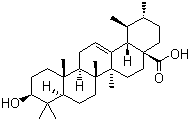
Ácido ursólico previne atrofia muscular.

Chega de choro: crianças já podem trocar espinafre por maçã e agradecerem aos pesquisadores de um estudo realizado na Universidade de Iowa. A casca da maçã contém uma substância cerosa chamada ácido ursólico que reduz a atrofia muscular e promove o crescimento de músculos em ratos saudáveis. Esta é a conclusão encontrada em artigo a ser publicado amanhã na revista Cell Metabolism.
 O estudo demonstrou que o ácido ursólico – também encontrado na uva ursi, de onde deriva seu nome – reduziu a atrofia muscular (conhecida por perda muscular) e promoveu o crescimento muscular em ratos saudáveis. Também reduziu os níveis de açúcar e gordura no sangue, triglicérides e colesterol em animais. Os resultados sugerem que o composto poderia ser utilizado para tratar a perda muscular e, possivelmente, distúrbios metabólicos como diabetes.
Christopher Adams, endocrinologista e pesquisador do estudo na referida universidade, explica que a atrofia muscular provoca grandes problemas. Também é muito comum, afetando a maioria das pessoas em algum momento de suas vidas, principalmente durante a doença ou envelhecimento. E não há nenhum medicamento para esta doença. Mas, agora os resultados do estudo dão novas esperanças de tratamento.
Quando os pesquisadores testaram o ácido ursólico em ratos, perceberam que estes animaizinhos tinham aumentado seus músculos em tamanho e força. O que aconteceu? O ácido ajudou dois hormônios que constroem músculos: fator de crescimento 1 (IGF1) e insulina. Surpreendentemente, o ácido ursólico também reduziu a gordura corporal, abaixou o colesterol e a glucose no sangue.
No estudo, a equipe utilizou uma nova técnica, mapeamento de conectividade, para comparar padrões de expressão gênica em células sob condições diferentes. Depois de determinar quais genes eram ligados e desligados em músculo humano durante a atrofia, a mesma equipe comparou os padrões com padrões de expressão gênica em linhas de célula de cultura tratadas com uma coleção de diferentes compostos. Descobriram que um destes compostos – ácido ursólico – causava um padrão de expressão gênica, oposto ao do padrão causado pela atrofia. Isto sugeriu que este ácido poderia reverter a doença. 
Em realização de experiências adicionais, os pesquisadores provaram que ratos alimentados com ácido ursólico foram, de fato, protegidos da atrofia muscular causada por jejum e lesões em nervos. Além disso, ratos saudáveis alimentados com ácido ursólico desenvolveram músculos maiores e mais fortes do que os ratos que não receberam o composto.


Matéria original do Portal Ciência Diária: Esqueça o espinafre: casca de maçã aumenta massa e força muscular

Artigo original do periódico Cell Metabolism:

Cell Metab. 2011 Jun 8;13(6):627-38.

mRNA Expression Signatures of Human Skeletal Muscle Atrophy Identify a Natural Compound that Increases Muscle Mass.

Department of Internal Medicine, Roy J. and Lucille A. Carver College of Medicine, The University of Iowa, Iowa City, IA 52242, USA; Department of Veterans Affairs Medical Center, Iowa City, IA 52246, USA.

Abstract

Skeletal muscle atrophy is a common and debilitating condition that lacks a pharmacologic therapy. To develop a potential therapy, we identified 63 mRNAs that were regulated by fasting in both human and mouse muscle, and 29 mRNAs that were regulated by both fasting and spinal cord injury in human muscle. We used these two unbiased mRNA expression signatures of muscle atrophy to query the Connectivity Map, which singled out ursolic acid as a compound whose signature was opposite to those of atrophy-inducing stresses. A natural compound enriched in apples, ursolic acid reduced muscle atrophy and stimulated muscle hypertrophy in mice. It did so by enhancing skeletal muscle insulin/IGF-I signaling and inhibiting atrophy-associated skeletal muscle mRNA expression. Importantly, ursolic acid’s effects on muscle were accompanied by reductions in adiposity, fasting blood glucose, and plasma cholesterol and triglycerides. These findings identify a potential therapy for muscle atrophy and perhaps other metabolic diseases.

Graphical Abstract:


PIIS155041311100177X.fx1.lrg.jpg


Copyright © 2011 Elsevier Inc. All rights reserved.

Publicado em notícias, nutrição, plasticidade muscular, suplementação | Deixe um comentário